
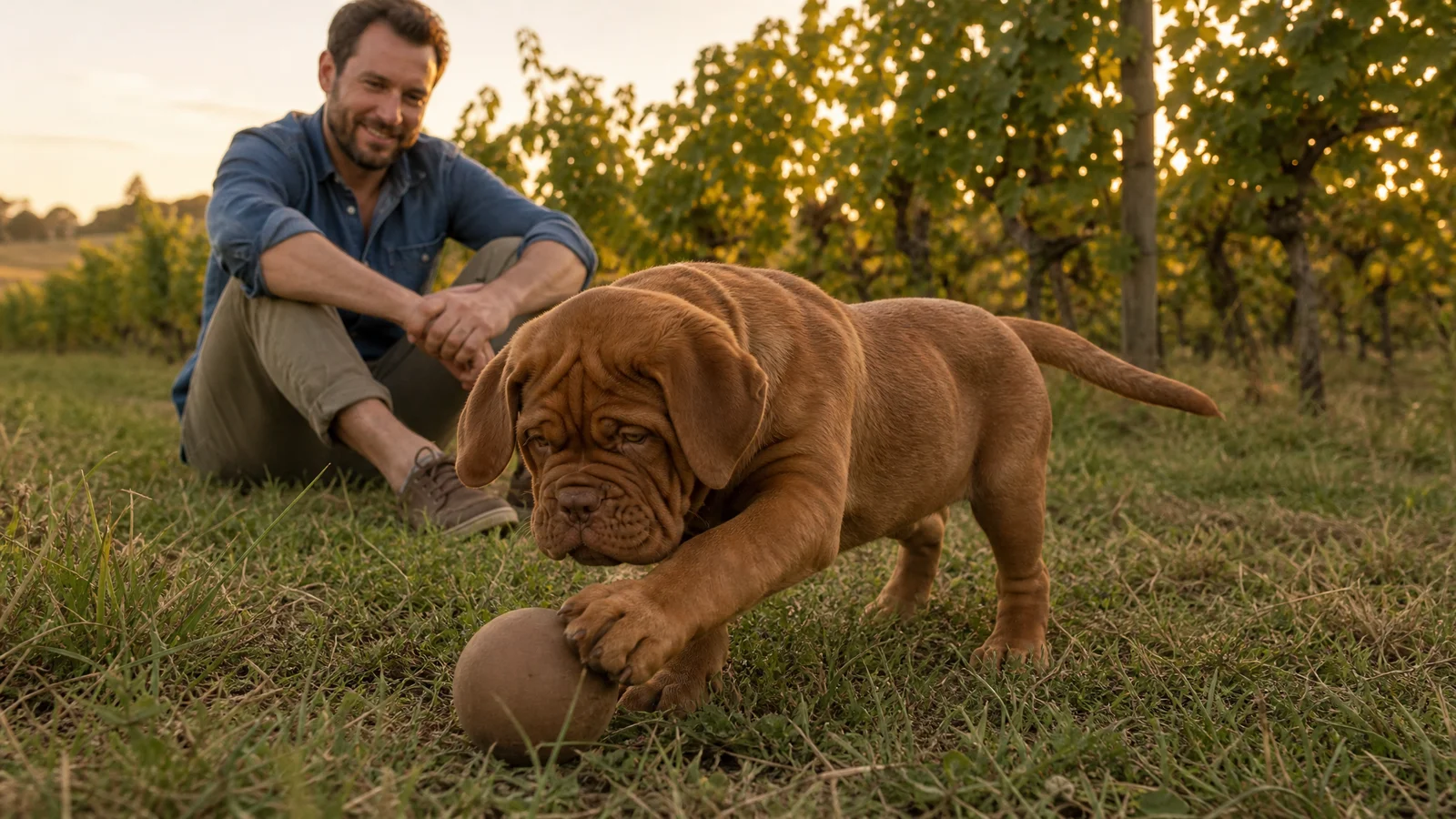
The last movement of a game is not always the end of the activity for a Dogue de Bordeaux puppy. A toy disappears, but the puppy still follows moving hands or looks for another round. Helping them change pace is a skill worth teaching, alongside choosing play that suits a growing body.
A workable day therefore needs more than alternating busy periods with an instruction to lie down. The puppy needs an understandable ending, a comfortable resting option and people who let the quieter period remain quiet.
Read on for a practical cycle: select manageable play, finish it clearly, protect the rest that follows and use what you observe to adjust the next opportunity. The details can change with your puppy's needs without turning the whole day into a rigid clock schedule.
Play Your Growing Dogue de Bordeaux Can Finish Comfortably
Choose an activity with a clear task and an easy stopping point. A puppy exploring a safe space or finding a nearby toy can participate without being asked to keep going until they are exhausted. That matters for a rapidly growing French Mastiff, whose enthusiasm and large appearance do not establish readiness for demanding physical work or prolonged exercise.
Let Exploration Stay Unhurried
A short opportunity to investigate a suitable area gives the puppy time to notice surfaces and smells. Let them move at a comfortable pace, with supervision and safe boundaries. The aim is an enjoyable experience rather than covering a distance selected before seeing how the puppy responds.
PDSA puppy exercise advice supports suitable play, short walks and gradual development. Ask your veterinarian how to apply those principles to your individual puppy, including their condition and the places available to you. A universal duration formula cannot make those decisions.
Notice the return route before starting. An easy outward exploration can become a more demanding outing if the puppy must repeat it when already ready to stop. Keep a practical way to end close at hand, especially when the surroundings are unfamiliar.
Give Shared Play a Small Job
Choose a suitable toy and a game the puppy understands. You might invite them to find an obvious toy nearby or share gentle play on a stable surface. Avoid making speed and repeated high excitement the only way the puppy can participate with you.
Prepare the space before beginning. Put away unrelated objects, leave room for turning and keep the exit to the resting area clear. A large puppy should not have to navigate a cluttered room while both dog and person are still moving.
- Use suitable toys that you can inspect and supervise.
- Choose secure footing and enough space for comfortable movement.
- Keep other pets out of a game if competition makes it harder to manage.
- Decide where the puppy will go when shared play finishes.
Use the puppy's response to choose which familiar game returns next time. A toy that repeatedly leads to frantic chasing may need a different presentation or a different activity. You can preserve enjoyable interaction while changing the part that makes finishing difficult.
Keep Learning Separate From Exhaustion
A brief rewarded skill can provide worthwhile interaction without becoming a long drill. Practice something simple that the puppy can already begin to understand. End while they can still engage easily, rather than repeating it until responses deteriorate and you must work harder to obtain another attempt.
RSPCA training advice favors short, manageable practice. In this daily cycle, that means leaving room for the puppy to move on. A successful lesson does not need another lesson immediately afterward to make the time useful.
A Clear Ending to Dogue de Bordeaux Play
Teach the transition while the game is still easy to manage. The adult chooses a recognizable finish, removes the shared-play equipment safely and helps the puppy reach a quieter option. Repeating that pattern makes the next activity more understandable than suddenly becoming unavailable while the puppy is still trying to continue the same lively exchange with your hands or clothing.
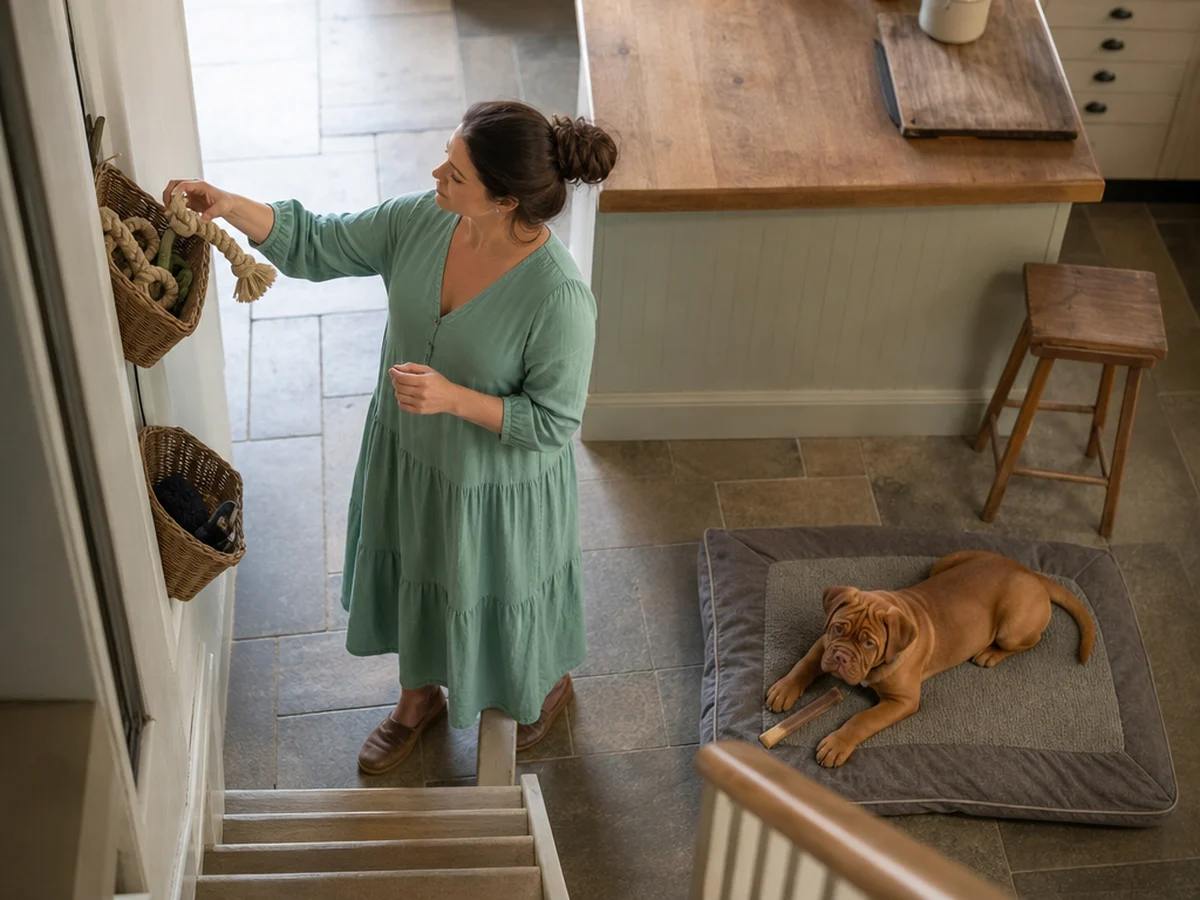
Recognize the Earlier Stopping Point
Watch for play becoming less coordinated, harder to interrupt or increasingly focused on the person's clothing. These changes are reasons to reconsider the activity, not invitations to keep going until the puppy stops on their own. Choose a smaller ending while you can still guide the situation comfortably.
Do not treat every lively moment as a problem. The useful distinction is whether both participants can continue comfortably and move into something else. A puppy can enjoy play while the adult remains responsible for its practical limits.
Put the Game Away Understandably
Use a consistent ending word if helpful, then follow it with the same calm actions. Retrieve equipment through a familiar comfortable exchange rather than starting a chase. The word becomes meaningful through the predictable change that follows it.
Keep the finish uncomplicated. A final excited invitation after announcing the end makes the pattern less clear, especially for a puppy still learning when shared play is available.
- Finish a manageable part of the activity.
- Recover and store the shared-play item safely.
- Offer the familiar quieter option or resting place.
- Let your own movement and voice become less exciting.
Store the toy out of the puppy's immediate reach after the exchange. Leaving it beside your chair can invite another round of investigation while you expect rest. Make the physical arrangement match the ending word so both parts of the message agree.
Offer a Bridge Into Quiet
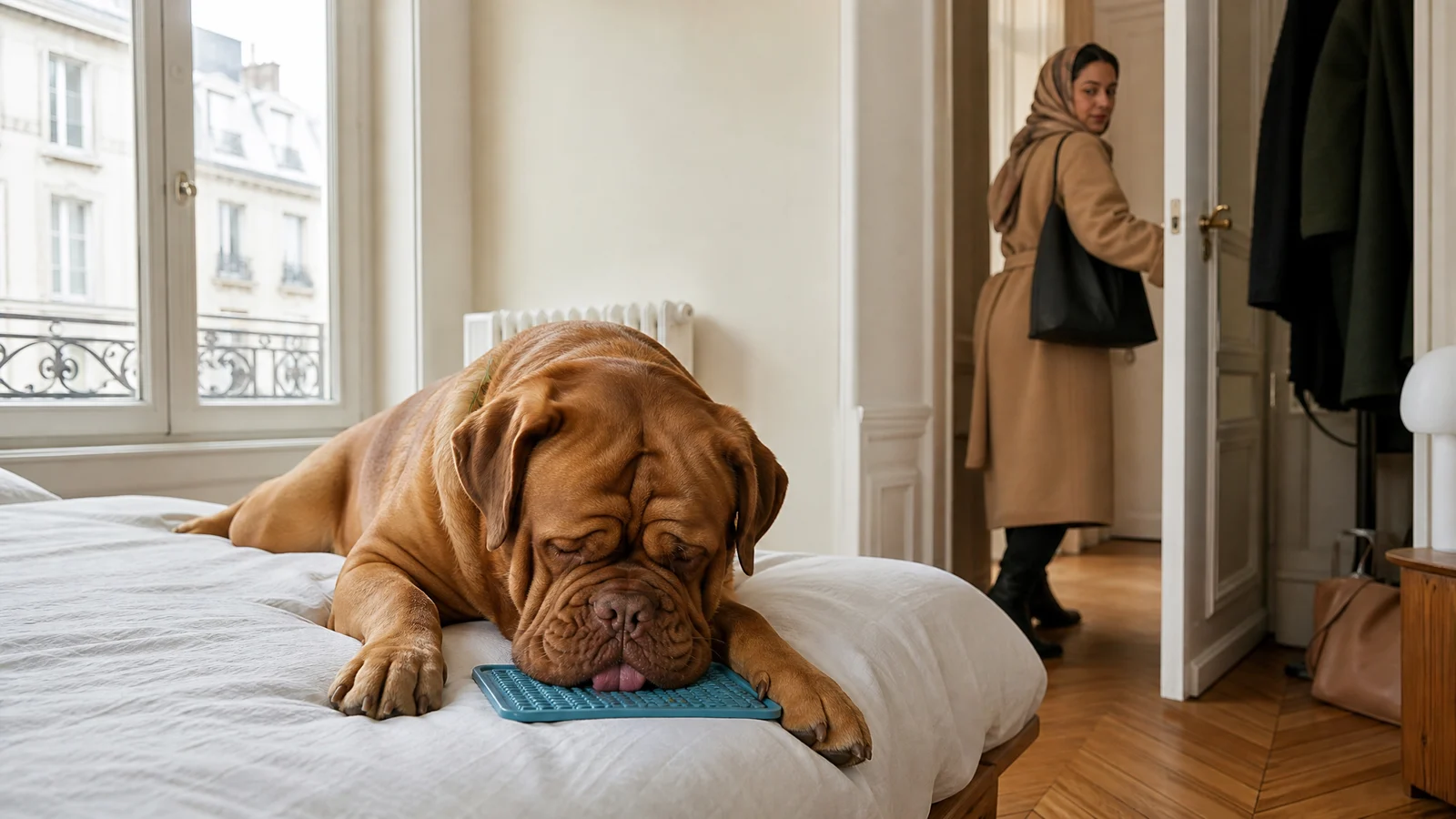
The puppy may benefit from a suitable supervised chew or calm company before sleep. Choose an activity that actually lowers the pace for that individual. An unfamiliar puzzle that produces frustration may be more work rather than a useful bridge out of play.
Keep water and necessary bathroom opportunities available. A puppy who needs to go outside may not settle simply because the game has ended. Check ordinary care needs before assuming that the resting lesson requires more practice.
Change the Ending When Mouthing Starts
If hands and clothing become targets, reduce the activity and create safe space. Our Dogue puppy mouthing guide examines those interactions in detail. An earlier finish can help, but mouthing has several possible contexts and should not automatically be treated as proof of tiredness.
Compare the easier and harder endings. Perhaps the puppy settles after quiet exploration but struggles after a busy gathering. That difference can guide your next choice without requiring you to remove all enjoyable play from the routine.
Protect the Rest That Follows Play
Rest needs a place and a household agreement. A puppy cannot learn to switch off if someone repeatedly touches them, produces another toy or calls them across the room. Arrange a comfortable option that is close enough for the puppy to feel secure while allowing the activity around them to become less demanding and more predictable.
Make the Resting Place Usable
Provide enough space for your growing Dogue to lie comfortably and change position. Keep the area away from a busy walkway or an absorbing view. The route to it should be straightforward, so reaching rest does not become another exciting tour of the house.
Check the actual room conditions. A warm, noisy or frequently interrupted corner may be unsuitable even if it contains a favorite bed. Moving the resting option can be more useful than repeatedly asking the puppy to settle in a difficult location.
Use barriers only in arrangements the puppy can handle comfortably. Being behind a gate is not automatically restful, especially if it separates the puppy from everyone without preparation. Quiet company can remain part of the transition while independence develops separately.
Reward Relaxation Without Restarting Play
Notice easy resting behavior during ordinary waking moments. A quiet reward delivered near the puppy can support the position they have chosen. Avoid waking a sleeping puppy or making your approach so exciting that they immediately get up to follow you.
Dogs Trust settling guidance builds from manageable behavior toward more relaxed responses. Look beyond a formal lying position. The puppy's ability to stop tracking your hands and remain comfortable while nothing is asked gives you useful information.
Allow some rest without continual interaction. The goal is not a puppy performing a long series of rewarded poses, but one who can spend part of the day comfortably disengaged. Your own quiet presence may be enough once the arrangement is familiar.
Tell other adults when the puppy has just finished a busy period. Someone arriving later may see a quiet puppy and assume it is time for a game. Sharing that small piece of context helps protect rest without requiring a complicated schedule.
Read the Rest Before Adding More Activity
Observe what the puppy does after the transition. A difficult resting period does not automatically mean they need more exercise, and an energetic invitation does not prove that another active game is appropriate. Examine the environment and ordinary needs before deciding.
The following observations help you choose an adjustment. They are prompts for closer attention rather than a way to identify a medical problem yourself.
| What You See | What to Review |
|---|---|
| The puppy gets up whenever someone passes | Traffic near the resting place |
| Every ending restarts toy searching | How clearly shared play finishes |
| The puppy cannot settle after a busy event | The amount of stimulation and need for a quieter setting |
| Rest or movement changes unexpectedly | Individual veterinary assessment |
Maintain regular veterinary visits and discuss persistent difficulty resting, unusual fatigue or changes in movement. Ask about appropriate activity as the puppy grows. The broader Dogue de Bordeaux exercise guide can help organize the routine around that individual advice.
The Next Play and Rest Cycle
Use the last comfortable ending to plan the next activity. Repeat what the puppy could enjoy and leave easily, then adjust one useful feature when they are ready. A familiar success has value even without adding a new challenge.
Keep adults aligned about the finish and protect the resting space afterward. If one person ends play while another immediately restarts it, the puppy receives a confusing picture of the day's rhythm.
Balance grows through these ordinary transitions. Your Dogue de Bordeaux needs suitable opportunities to explore, learn and interact, followed by rest that is genuinely available. A sustainable cycle is more useful than a day built around exhausting the puppy into silence.
 BehaviorDogue de Bordeaux Temperament: Motivating the Stubborn Ones
 CareMaking Wrinkle, Ear and Nail Care Easy for Your Dogue de Bordeaux
 BehaviorCan a Dogue de Bordeaux Be Left Alone? Teaching Calm Time Apart