
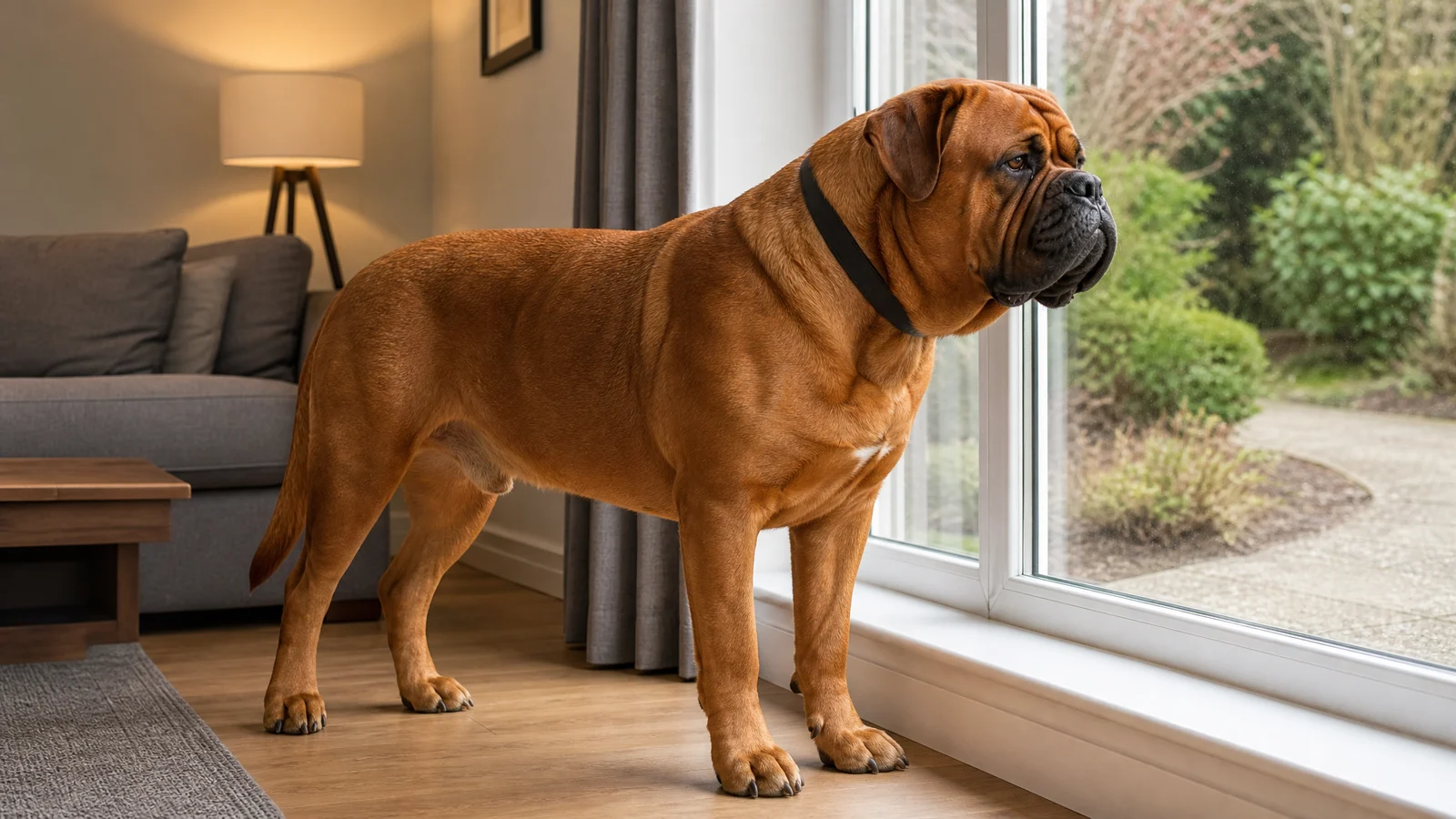
Your Dogue de Bordeaux guards the home because the breed was built to watch and stand firm. That stance is an instinct you manage, not a skill you teach, and the door, the front window and the fence line are simply where the watching happens.
The breed earns the top mark for watchdog and protective nature, 5 of 5, and the standard describes a dog gifted for guarding who acts with "vigilance and great courage but without aggressiveness." Handled badly, that stance turns into barrier barking and lunging from a very large dog. Handled well, you get a calm, imposing presence that checks in with you instead of deciding alone.
Below, you'll find the four tools that shape this behavior, including rewards, gear, spaces and daily routines, plus a two-week plan that ties them together.
Guarding Instinct in the Dogue de Bordeaux
The breed's history explains the stance at your door. In the Aquitaine region of France, these dogs guarded homes and cattle, hunted large animals such as boar and worked for butchers. Careful breeding has since softened that old temperament, and today the Dogue is a natural guardian, vigilant and courageous without being aggressive.
So you are not erasing a flaw, you are giving a trait some shape. The standard also calls the French Mastiff calm and balanced with a high stimulus threshold, which means a well-bred dog should not need much to stay settled. When yours reacts to every leaf outside the window, your job is to rebuild that threshold with rewards and setup, never to teach more guarding.
What a Healthy Watchful Stance Looks Like
A healthy stance is brief and easy to read. Your dog lifts their head, goes still, looks toward the sound or the door and may give a few barks. Then they check in with you and settle once you acknowledge what they noticed.
Barking in this breed is typically occasional, not constant. A dog who cannot stop is telling you the setup or their stress level needs work. Aim for a stance with a working off switch, and make that switch faster each week.
Signs the Stance Has Become a Problem
Trouble looks different. Watch for hard staring, a stiff body, lunging at the gate or glass, barking that runs long after the trigger is gone, or a growl at a person. Growls are warnings, so thank your dog for the information and calmly add distance. A dog who learns that warning is useless may skip it next time.
If your dog also guards bowls, chews or beds, that is resource guarding, a related but separate issue that is typically based in anxiety. Lunging, snapping, biting, a stance that worsens despite steady practice, or a sudden behavior change all call for help. Start with your veterinarian, who should see your dog regularly anyway, to rule out pain or illness. Then bring in a certified behavior professional who uses reward-based methods.
To see how your dog handles children, other dogs and visitors more broadly, read our article on socializing a Dogue with kids, dogs and strangers. Good early exposure makes every tool below work better, because a dog who finds new people ordinary has less to guard against.
Rewarding Calm Guarding at the Door
Rewards come first because they tell your dog what the watching should turn into. Dogues are devoted and sensitive, and they can also be stubborn, so pay fast and pay well. Keep a pouch of small, soft, high-value treats near the front door, plus a marker word such as "yes" that you say the instant your dog does something right.
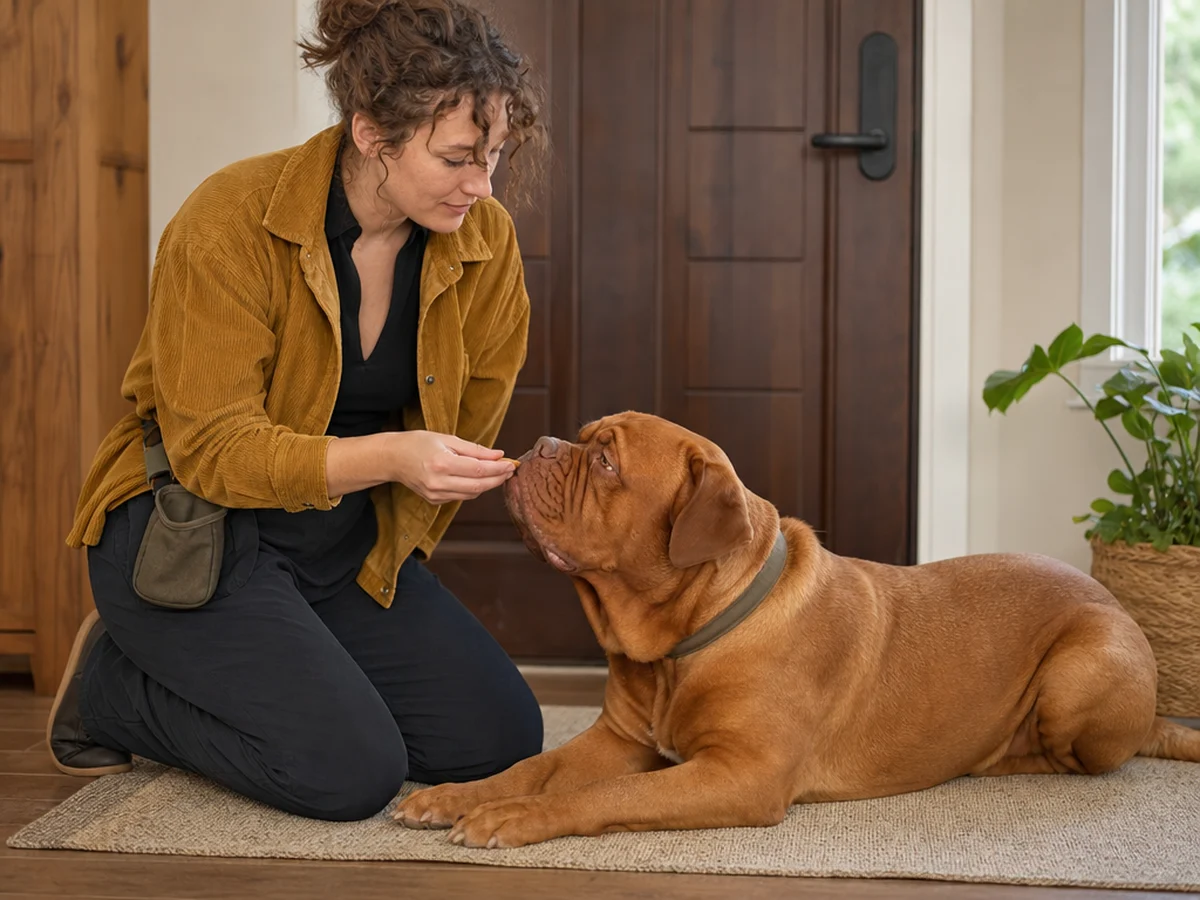
What you pay for matters more than what you pay with. The best moment to reward is before the bark, when your dog notices a sound and has not reacted yet. Mark the noticing and deliver the treat low and close to the mat, so your dog learns that spotting a trigger is the start of something good, not an emergency.
Moments Worth Paying For
Moments worth paying for include a glance at the door or window followed by a look back at you, and staying on the mat while a recorded doorbell plays at low volume. Pay for a quiet pause after one or two barks, even a brief one. Pay for turning away from the window when you invite them off it, and for lying down calmly while a visitor sits across the room.
Treats are not your only currency. The door opening, the leash clipping on, a sniff-heavy walk and a visitor finally getting to say hello are all life rewards, and you can make each one depend on calm behavior. Once the mat habit is reliable, pay on an unpredictable schedule so the behavior holds without a constant stream of food.
Sometimes a guarding dog grabs a sock or chew near the door and stiffens when you approach. Skip the tug-of-war and put food down away from the item, so your dog moves off and you can pick it up safely. This breed also needs real mental work, so finish hard sessions with a food puzzle or chew. A mentally full dog has less energy left for patrolling.
Does Gear Help or Hurt Door Guarding?
Gear helps when it manages the space and hurts when it adds pressure or lets a heavy dog win. Your French Mastiff is massive and powerfully built, so every piece must be sturdy enough for the worst moment, not the average one. Choose tools that create distance and calm, then reward inside that structure.
Gear That Helps
A heavy, solid gate or exercise pen across the hallway is the single most useful item. It lets your dog see the door area without standing on it, and it lets guests come in without a rush. Anchor it into the wall or frame, because a dog determined to reach the door should not be able to push it aside.
A well-fitted harness and a sturdy leash give you control for planned greetings, and they spread the load across the chest. Add a non-slip mat or bed for the settle spot, a long-lasting chew that only appears at doorbell moments, and your treat pouch within reach. Chews that appear only for visitors become a signal that guests mean good things.
Gear to Skip
Skip retractable leashes. A big dog can hit the end of one at speed, and you lose the ability to guide them away from a trigger. Skip lightweight pressure-mounted gates too, since a determined Dogue can lean them out of place, and an easy escape teaches that the barrier is optional.
Also skip any setup that leaves your dog tied or stuck at the door with no way out. A dog who cannot move away from a trigger is far more likely to escalate. Whatever you use, your dog should always be able to retreat to the settle spot.
Spaces That Shape Where Your Dogue de Bordeaux Watches
Dogs guard what they can see, so the layout of your home largely decides how much your French Mastiff feels they must guard. Every front window with a street view is a constant stream of trigger practice. Change the view and you change how often the stance switches on.
Start with the windows. Apply frosted film to the lower panes, close blinds on the street side or move furniture so your dog cannot perch on the sill. Give them a view of something calmer, such as a back room or a window facing the yard, where nothing passes by every few minutes.
Next, look at the door itself. Place the settle spot several steps back from the entry, off the direct line of sight to the door but within view of you. A gate between the spot and the entry makes this easier. If you live in an apartment, hallway noises are the main trigger, and our guide to Dogue apartment and house manners covers how to set up a quiet zone.
Finally, handle the fence line. A dog who runs the fence barking at passersby is rehearsing the behavior many times a day. Block the street-level view with a solid screen or planting, supervise yard time, and call your dog in with a reward before the barking starts. Offer plenty of sniffing and chewing in the yard so it is a place for relaxing, not patrolling.
Which Routines Keep Guarding Manageable?
Routines lower tension before the doorbell ever rings. A dog whose day is predictable, with exercise, sniffing, chewing and rest in regular places, enters visitor moments less wound up. The breed is adaptable and bonds closely with family, so steady habits give them confidence that you are handling the door.
Build the day around enough activity to take the edge off and enough mental work to use their brain, without overdoing hot or heavy exercise. Food puzzles, sniff walks and short training games all count. Then add a regular rest period in the settle spot, because a dog who rests well is less reactive.
Before the Visit
Prepare your dog and your guests before anyone arrives. Run through this short sequence each time:
- Walk your dog and offer a chew so they meet the moment relaxed.
- Place them on the mat behind the gate with a treat scatter.
- Tell guests to come in calmly, skip eye contact and ignore the dog entirely.
During the Visit
Common advice says to let your dog greet every guest so they learn visitors are safe. For a breed rated vigilant, forced greetings often raise the stakes. Let your dog stay on the mat and watch, and reward calm. If they choose to approach loosely and with soft body language, a brief hello is fine, and you end it before they tense.
Keep treats flowing for relaxed behavior while guests settle in. If your dog stiffens, stares or barks hard, calmly move them back behind the gate with a chew. That is a mild, reward-compatible time-out, not a punishment.
After the Visit
When guests leave, give your dog a chance to decompress. Offer water, a chew and quiet time in the settle spot. Praise the settling and note anything that seemed hard, such as a particular guest or a loud entry, so you can adjust next time.
Two Weeks of Guarding Practice
This plan turns the toolkit into daily practice. Keep sessions short and stop while your dog still looks eager. If a step feels too hard, repeat the previous one for a few more days, because progress is not a straight line and dogs vary.
Spend the first days on spaces and gear. Install the gate, apply the window film, place the mat and decide where the chew lives. Then teach the mat in a quiet room with no doorbell, marking and paying every time your dog steps on and lies down.
By midweek, add a recorded doorbell at a low volume and pay for calm noticing. By the end of the week, your dog should head for the mat when the sound plays, even if they still bark once or twice.
Now practice real moments. Have a calm friend ring the bell, enter quietly and sit while your dog stays on the mat behind the gate. Reward settling the whole time, and keep early visits brief.
Work up to a full visit with the before, during and after routine, and rehearse the yard fence line with supervised, rewarded recalls. Track one thing throughout: how quickly your dog returns to the mat and relaxes after a doorbell. That time shrinks as the stance and the off switch learn to work together.
Guarding will always be part of who your French Mastiff is. Give that instinct a clear job, such as noticing, checking in and settling, and you keep the vigilance the breed is known for without the barking, lunging or tension.
 Training basicsTeaching Your Dogue de Bordeaux to Relax Alone in a Crate
 Training basicsCan a Dogue de Bordeaux Live in an Apartment?
 CareExcessive Drooling? Teach Your Dogue de Bordeaux the Towel