
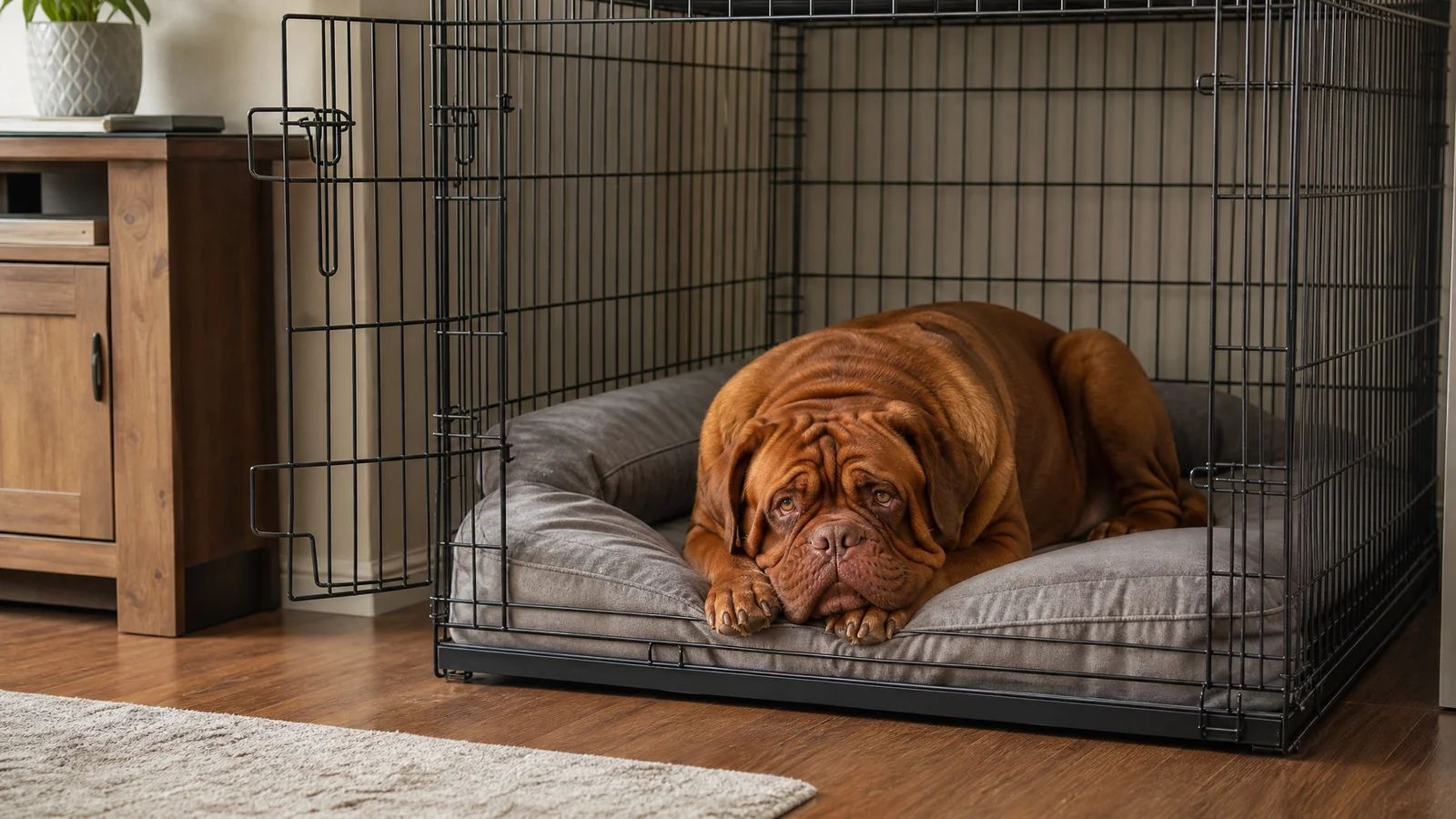
Crate training changes when the learner is a deeply attached dog who will occupy a great deal of floor space. The crate must allow a Dogue de Bordeaux to stand, turn, and rest comfortably, but size alone does not create safety. They also have to learn that entering, staying, and being alone are different skills.
This guide is organized by what you see at the crate. We will read voluntary entry, door frustration, failed settling, and distress during absence, then match each picture to a reward-based next step. We will also decide when a gated room is the better tool. The aim is flexible rest, not making confinement the answer to every household problem.
Dogue de Bordeaux Crate Training Starts With Fit
A usable crate supports the dog's whole resting posture. They should be able to stand without ducking, turn without folding themselves around the door, and lie on their side if that is how they relax. Measure the individual dog rather than buying from a breed label.
For a growing puppy, a divider can preserve a comfortable sleeping area while the crate still fits the room. Check the fit often because Dogues grow into substantial adults. Place the crate where family life is visible without putting the dog in the path of doors, direct heat, or constant foot traffic.
Watch how the dog chooses to sleep outside the crate. A Dogue who stretches fully on cool flooring needs a different resting picture from one who curls on a padded bed. The crate setup should accommodate natural preferences rather than force one compact posture.
- Choose a stable crate with space for natural movement and no sharp points, loose hardware, or gaps that could catch a paw.
- Add bedding only when the dog rests on it safely, and remove anything they tear apart or try to swallow.
- Keep water needs and room temperature in mind, especially when the dog will rest longer than a brief practice round.
- Leave enough clear space around the crate for the door to open fully and for a large dog to enter without twisting.
Regular veterinary checkups support crate planning because comfort can change with growth and age. If your Dogue suddenly avoids a posture or surface they previously liked, discuss the change with your veterinarian rather than turning entry into a contest.
Dogue de Bordeaux Crate Training Stops at the Door
Stopping at the threshold usually means the next step is too large, not that the dog has rejected crate training forever. The doorway, floor texture, sound, or depth can be unfamiliar. Remove pressure and reward investigation before asking for the whole body.
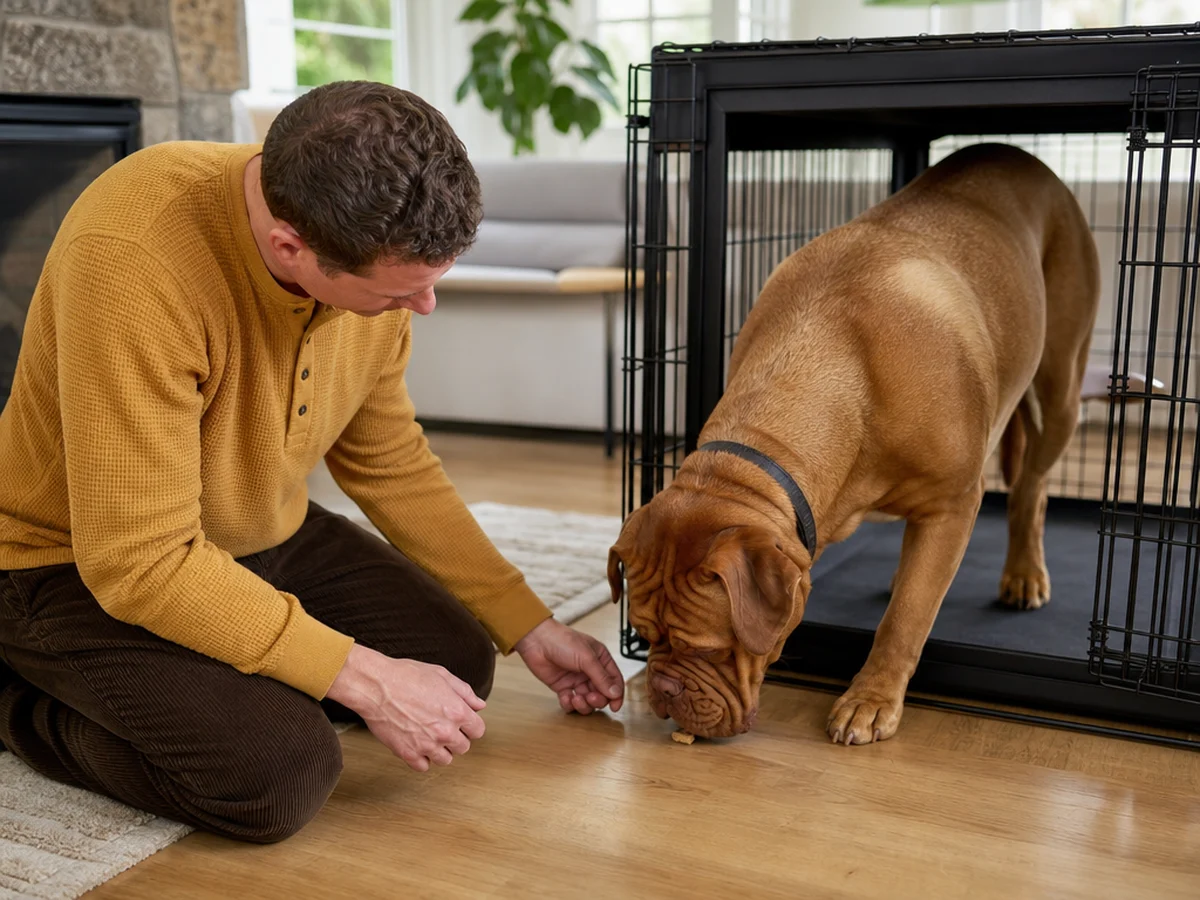
Best Friends crate guidance recommends marking and rewarding each movement toward the crate, including a nose inside. Tossing every reward to the back may lure a worried dog farther than they intended, so begin where curiosity is still easy.
Entry Becomes a Shaping Game
Sit beside the crate with the door secured open. Mark a glance, a step closer, or a paw across the threshold, then deliver the reward where the dog can eat without feeling trapped. Occasionally place the reward outside so leaving remains available.
When the whole body enters willingly, feed several rewards one at a time. Give a release while the dog still looks settled, then let them leave at an ordinary pace. Add an entry cue only after the French Mastiff crosses the threshold predictably.
The Room Can Change the Answer
A crate in an isolated laundry area may feel very different from one near the family. Try a calmer social location before assuming the crate itself is the problem. A nonslip mat outside the entrance can also help a heavy dog approach with confidence.
Crate Training Changes When the Door Moves
A dog who naps inside while the door stays open has learned that the space is comfortable. They have not yet learned that a moving or closed door is safe. Treat the hinge, latch, and duration as separate pieces instead of closing the door and waiting for acceptance.
Touch the door, mark calm behavior, and reward. Move it a little, reward again, and reopen it before the dog shifts toward escape. Build to a soft latch only when the earlier motion has become ordinary. Stay close while this new piece is taking shape.
| What you observe | What it may mean | Next useful change |
|---|---|---|
| The dog leaves when the door moves | Door motion is not yet neutral | Return to tiny movements with the exit open |
| The dog takes food but stands ready | The step may be possible but not restful | Shorten it and reward a softer posture |
| The dog lies down after the latch | That duration may be comfortable | Open before rest turns into concern |
| The dog escalates rapidly | Confinement may be adding stress | Stop and use a larger safe area |
The table is a way to choose the next repetition, not a final explanation. Behavior can change with context, noise, fatigue, and whether a person is present. Read the whole dog, including posture and recovery, instead of grading success by silence alone.
Test only one variable in a practice round. If you close the door, leave the room, and add duration together, a worried response cannot tell you which element became difficult. Separate changes give the dog a fairer lesson and give you clearer information.
Reopen the door during calm behavior whenever possible, but do not leave a frightened dog trapped while waiting for perfect silence. Safety comes first. Make the following repetition much easier so calm can be reinforced without a contest.
Alone Time Is Not the Same as Crate Time
A Dogue can love an open crate and still worry when people disappear. Practice household distance outside the crate so absence does not become tangled with confinement. Step behind a gate while the dog works on an easy food search, then return before concern grows.
The breed's strong family affection makes this distinction especially important. Begin with ordinary independence such as resting on a mat while you move across the room. Our guide to Dogue apartment manners explains how settling supports shared spaces and short periods apart.
Departure Cues Need Their Own Practice
Keys, shoes, and a closing door can predict absence long before the person leaves. Pick up the keys, place them down, and continue an ordinary evening. Put on shoes and make a snack. Small harmless rehearsals can loosen the connection between one object and a long separation.
Then practice a very brief exit while the dog remains comfortable, returning without a dramatic greeting. Increase absence only after the current version looks easy. If your Dogue stops engaging with a valued activity or waits rigidly at the exit, the step was too hard.
Family Movement Should Become Background
Reward the dog for staying settled while one person stands, walks away, and returns. Vary which household member moves so calm does not depend on one exact picture. This is practical daily Dogue training, not emotional distance from an affectionate dog.
Crate Distress Needs a Different Plan
Whining that fades as a dog finds a comfortable position is different from escalating panic. Repeated escape attempts, frantic movement, heavy drooling unrelated to normal jowls, or an inability to engage with food means you should stop increasing difficulty. The crate may be worsening the experience.
The ASPCA separation guidance notes that crates help some dogs but add stress for others. A dog who is calmer in a safe room behind a gate is giving useful information. Choose the setup that supports calm rather than insisting on one tool.
Frustration Can Improve With Smaller Steps
A dog may object when a door closes because they expect access to you or the room. If they can pause, eat, and recover quickly, return to an easier duration and reward calm before the objection starts. Also practice closed-door rest while you remain nearby.
Do not wait through a steadily worsening response to prove that noise does not work. That approach risks rehearsing distress and changes nothing about how the dog feels. Arrange the next repetition so calm behavior is possible from the start.
Severe Absence Distress Needs Support
If the dog cannot tolerate even easy departures, stops eating, or risks injury while trying to escape, suspend crate absences. Use the safest workable arrangement and contact a qualified reward-based professional. Your veterinarian should also be part of the conversation when behavior changes suddenly or distress is intense.
Crate Training Must Stay a Choice-Rich Skill
The RSPCA crate guide presents this space as a refuge rather than a place for punishment. Keep that standard visible in daily use. Invite entry, pay rest, and provide exercise, social contact, bathroom trips, and time outside the enclosure.
Useful crate practice may include meals with the door open, a chew while you sit nearby, or a brief settled pause during household activity. It should not become the default response to normal puppy energy or every inconvenient moment. Management has to meet the dog's needs as well as protect the room.
Plan what happens after the door opens. Release into a calm bathroom trip, a drink, or quiet contact instead of an explosion of play. A steady exit helps the crate remain part of an ordinary routine rather than a pressure chamber between exciting events.
- Continue only while the dog enters willingly and can soften into rest rather than merely becoming still.
- Separate door work, duration, distance, and absence so only one part becomes harder at a time.
- Use a gated room or another safe area when the crate clearly produces more stress than comfort.
- Revisit size, location, temperature, and daily activity whenever crate behavior changes.
Long-Term Dogue de Bordeaux Crate Training Comfort
The best long view is broader than increasing time behind a closed door. It looks like a Dogue who enters without hesitation, rests with a soft body, and can also relax in other safe places. The crate becomes one option inside a flexible household routine.
Some Dogues may prefer a mat near their people, while others keep choosing the denlike space. Respect that information and keep alone-time practice separate. A close-bonding dog does not have to love isolation, but they can learn that brief, well-prepared absences end safely.
 Training basicsCan a Dogue de Bordeaux Live in an Apartment?
 CareExcessive Drooling? Teach Your Dogue de Bordeaux the Towel
 Exercise and jobsCart Pulling, Rally or Agility: Which Jobs Suit a Dogue de Bordeaux?