
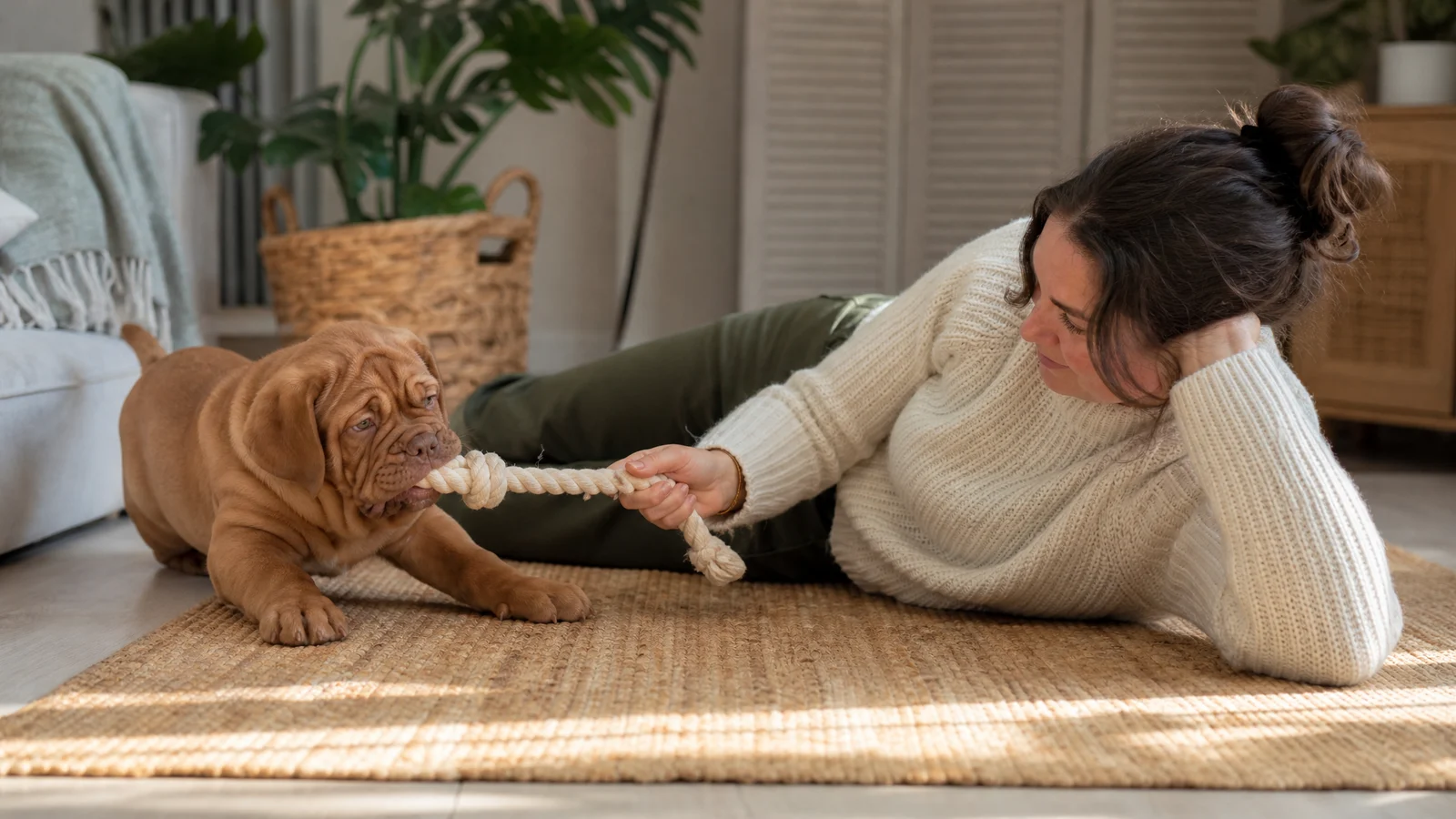
Hands reaching toward a collar, sleeves moving past a chair and a toy moving across the floor can invite very different responses from a Dogue de Bordeaux puppy. If the mouthy moment always ends with the same rushed toy offer, you may miss what started it. Changing the interaction before teeth arrive often gives you a more useful lesson.
This article follows the moments around mouthing: the approach, the available toy, the person's movement and the pause afterward. We will make gentle contact rewarding, protect clothing without turning it into a game and help the puppy return to a calmer activity. A growing French Mastiff needs practice that adults can maintain as the puppy becomes stronger, with rest and professional support when the pattern calls for them.
The Moment Before Dogue de Bordeaux Mouthing
Notice what immediately preceded the contact. A puppy may reach for moving fabric during play, mouth a hand that interrupts them or grab when an exciting interaction begins. Those observations do not assign a motive with certainty, but they help you change the part of the situation that keeps recurring.
Keep your account concrete enough for another adult to recognize. Saying the puppy is wild gives fewer useful choices than describing teeth reaching for a sleeve when someone bends down.
| Moment You Notice | First Adjustment to Consider |
|---|---|
| Hands enter energetic play | Prepare a suitable toy before interaction begins |
| Moving clothes become the target | Change the route or manage access during busy movement |
| Touch repeatedly produces mouthing | Make handling gentler and assess comfort |
| Play becomes harder to interrupt | Offer an earlier ending and an appropriate rest opportunity |
Compare easy interactions too. The person sitting quietly with a toy may get a different response from someone moving quickly past the puppy. That contrast can reveal a manageable version of the activity without deliberately provoking another mouthy episode.
Watch what follows the contact as well. Fast hand movement, excited voices or a chase can keep the interaction active. The aim is to make an appropriate choice easier, while keeping your own response safe and understandable. Note whether the same pattern happens with every adult or only during one particular activity.
Prepare Toys Before Puppy Mouthing Begins
A useful toy needs to be available before your hands become the activity. Keep suitable options near the places where you normally interact, stored where adults can reach them. Choose items that suit the puppy's current size and way of using them, then supervise rather than trusting a durability label.
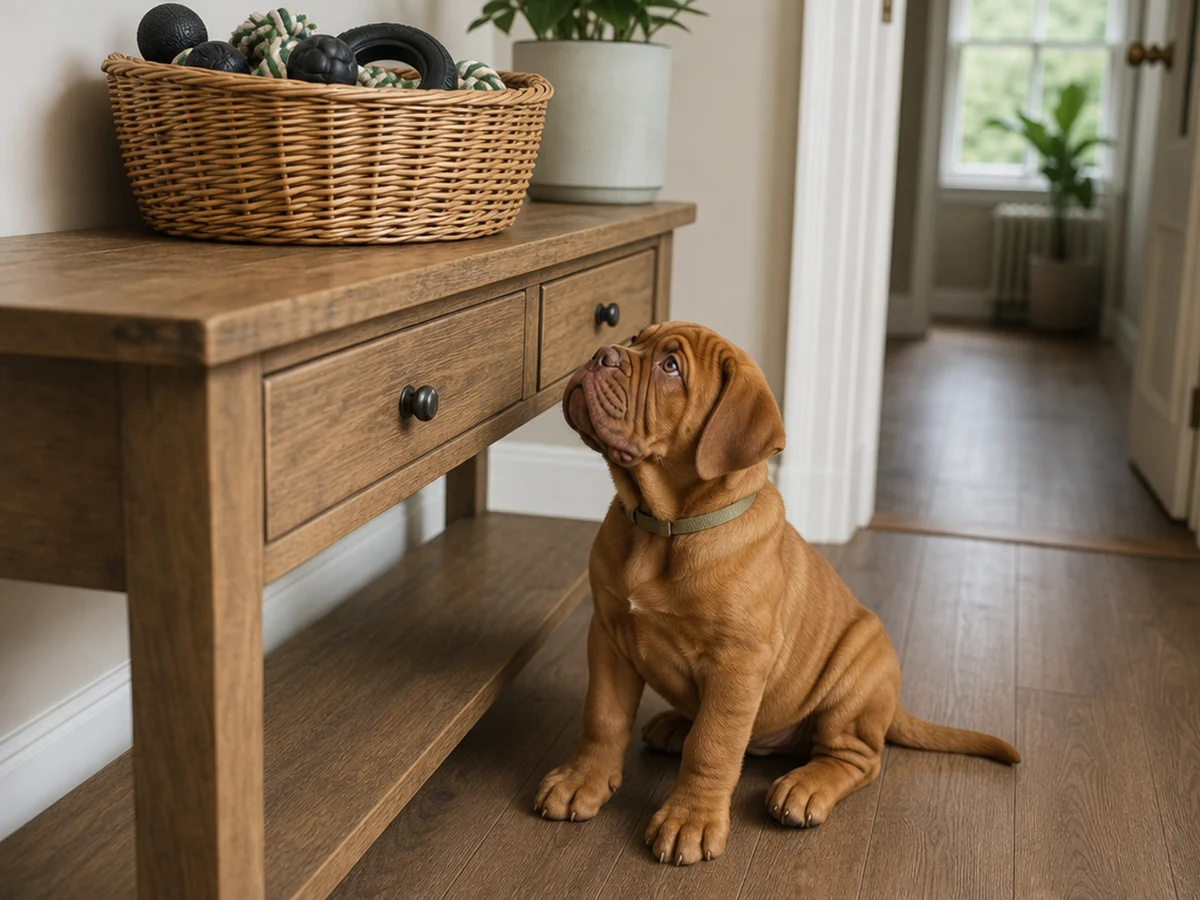
A toy that gives your hand some distance from the puppy's mouth can make shared play easier. Present it at a comfortable height, with enough room for the puppy to take it without jumping into you. Keep the game on a stable surface.
Humane World chewing advice supports giving puppies appropriate alternatives and managing access to belongings. The practical distinction here is between an item for supervised shared play and an item suitable for quiet chewing. They need not be the same object.
- Inspect the toy for loose parts or damage before offering it.
- Choose something the puppy can use without your fingers beside their teeth.
- Put unsuitable household belongings out of reach before play begins.
- Remove an item safely when its condition no longer supports continued use.
Keep a familiar successful option available when introducing something new. If the puppy does not understand the new toy's purpose, you can return to an easier activity without using your hands to generate excitement. Preference becomes useful information when you observe actual use.
Gentle Contact With Your Dogue de Bordeaux
Teach the puppy that a person's approach can be comfortable without becoming mouth-first play. Start during an easy waking period, with the puppy free to move away. Brief touch followed by a suitable reward gives you a simpler lesson than reaching repeatedly into a busy game.
Begin where your puppy already accepts contact. A gentle touch near the shoulder may be easier than handling paws or reaching around the face. End the touch before the puppy becomes worried or starts treating your hand as something to catch.
Battersea's reward timing guidance helps explain how a familiar marker can identify the response you wanted. Acknowledge comfortable participation and deliver the reward in a way that does not require the puppy to grab at your fingers.
If mouthing starts whenever you touch a particular area, reduce the handling and discuss the pattern with your veterinarian. Do not assume that every use of teeth during contact is ordinary play. The setting, the puppy's posture and any change from normal behavior all matter.
Keep everyday handling separate from deliberate toy games. Adults can use a toy for shared play and a quieter approach for touch, giving the puppy clearer information about what is happening. Children need adult guidance and supervision rather than responsibility for teaching this distinction themselves.
Moving Clothes and Puppy Mouthing
Sleeves, pant legs and dangling fabric can become especially interesting when people move quickly. Arrange busy household tasks so the puppy does not repeatedly practice grabbing them. A comfortable nearby area behind a suitable barrier may be more practical than asking everyone to move perfectly throughout a hectic morning.
When you can supervise, begin with small ordinary movements while the puppy has an appropriate activity. Reward staying with that activity or remaining comfortably grounded. Increase the movement only while the puppy can keep making an easy choice.
Avoid making a grabbed sleeve into a pulling game. Pause the movement if doing so is safe, use a familiar alternative and create space. After the immediate moment, change the arrangement that allowed the puppy to reach the moving fabric again.
Check the human route through the room. Passing close to the puppy's resting place with swinging clothing can make the same mistake likely each time. Moving the activity space or using another route gives you a practical change that does not depend on repeating a cue.
Share that adjustment with everyone in the household. A rule that works only for the person who discovered it will leave the puppy receiving inconsistent experiences. Keep the explanation specific, such as where to store the toy or which route to use during the busiest task.
Pause Mouthy Play and Return Differently
When teeth become painful or play loses its comfortable pattern, pause the interaction safely. Give the puppy a chance to settle, then decide whether to resume an easier game or move into rest. Returning immediately to the same exciting movement can restart the part that was already becoming difficult.
The ASPCA puppy mouthing guidance explains the connection between gentle play continuing and painful play stopping. Keep your response calm and brief enough to be understandable, with safe space between the puppy's mouth and the person.
Choose the next step from what the puppy can do after the pause. You do not need to complete a planned game simply because you have already begun it.
| After the Pause | A Useful Next Step |
|---|---|
| The puppy can engage gently with a toy | Resume a smaller, calmer version of shared play |
| Movement immediately restarts grabbing | Change the activity and manage access to clothing |
| The puppy has difficulty settling anywhere | Review rest, comfort and the day's stimulation |
Make the ending visible to the household. Put shared-play equipment away and help the puppy reach the familiar next activity. That transition is part of the lesson, rather than an unimportant gap between games.
Children and Guests Need a Mouthing Plan
Visitors may unintentionally restart the game with lively hands or quick retreating steps. Explain the arrangement before introducing the puppy. A large growing dog needs adults to manage the environment, especially when children or anyone vulnerable to being knocked over are present.
Keep the instructions simple enough to use without improvisation. Children should have an easy way to get an adult, while the adult remains responsible for separating play and arranging safe contact.
- Use suitable toys for shared play instead of offering hands as targets.
- Keep children out of energetic play that adults are still learning to manage.
- Provide a comfortable puppy area when attention must move elsewhere.
- End an interaction while it is still manageable, rather than waiting for a painful grab.
Not every visit needs a puppy play session. Calm observation from separate spaces can be a useful outcome, particularly when several people are moving around. The puppy can still have appropriate company without being passed between excited guests.
For the broader routine, our Dogue play and rest guide explains how to finish activity and protect downtime. A dependable rhythm helps adults choose better moments for social interaction.
Rest Needs and Changes in Dogue de Bordeaux Mouthing
A puppy who has had a busy stretch may need an easier environment and a rest opportunity. Do not automatically add more energetic play when grabbing increases. Look at the whole sequence of activity, interruption and recovery before deciding what the next part of the day should contain.
Provide a familiar place where the puppy can rest without repeated touching or invitations to play. Rest should not become another difficult performance. Quiet company nearby may help, while the puppy's response tells you whether the arrangement is actually comfortable.
Keep regular veterinary visits and raise sudden changes, persistent discomfort or mouthing associated with particular handling. Seek qualified reward-based behavioral support when contact is unsafe or the puppy cannot participate comfortably despite sensible adjustments.
Our Dogue adolescent training guide follows the next stage of learning. Growing strength makes consistency valuable, but age alone does not explain every difficult interaction. Continue to observe the actual trigger and response rather than waiting for a birthday to solve it.
Compare progress in ordinary tasks, such as walking across the room or briefly touching a shoulder. Fewer interruptions and an easier return to a toy are useful improvements. They tell you more than expecting every puppy interaction to be perfectly gentle immediately.
Comfortable Contact With Your Dogue de Bordeaux
Prepare the toy, notice what starts mouthing and change the interaction before it becomes difficult to manage. Reward gentle participation and give play a clear finish. Your Dogue de Bordeaux learns through those repeated ordinary moments, with adults arranging the space and rest that make good choices possible as the puppy grows.
 Exercise and jobsBalancing Play and Rest for a Growing Dogue de Bordeaux
 BehaviorDogue de Bordeaux Temperament: Motivating the Stubborn Ones
 CareMaking Wrinkle, Ear and Nail Care Easy for Your Dogue de Bordeaux